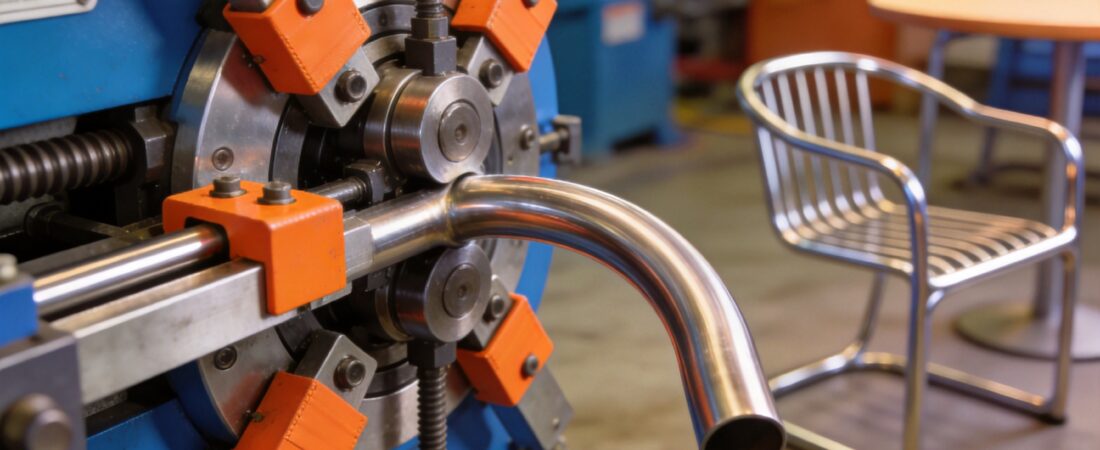
Bending pipe for furniture making requires a meticulous balance between aesthetic precision and structural integrity. Unlike heavy industrial piping where internal flow or weld seams dictate the parameters, furniture fabrication demands zero visible defects, tight dimensional tolerances, and absolute repeatability across production batches. The key takeaway for any fabricator is that achieving flawless metal furniture frames relies on understanding material springback, selecting the correct centerline radius relative to wall thickness, and utilizing specialized tooling like wiper dies and internal mandrels. This comprehensive guide details the exact engineering principles, step-by-step methodologies, and equipment selection criteria necessary to produce high-quality bent pipe components for chairs, tables, and decorative frames without compromising the metal.
Understanding Pipe Bending for Furniture Fabrication
The fundamental difference between structural pipe bending and furniture fabrication lies in the visual and tactile requirements of the final product. When bending pipe for furniture making, the outside radius of the bend becomes the primary visual focal point. Any wrinkling, ovality, or surface scratching on the extrados immediately disqualifies the part from assembly. This unique perspective means fabricators must prioritize surface finish and extrados stability over the intrados compression management typically favored in structural plumbing or handrail applications. You are not just shaping metal; you are crafting a visible architectural element that consumers will touch and inspect daily.
To achieve this level of perfection, we must look at the material science governing the deformation process. According to ASTM A240 standards for chromium and chromium-nickel stainless steel plate, sheet, and strip, the yield strength and tensile strength directly influence how the material behaves under bending stress. High-yield materials like 304 stainless steel exhibit significant work hardening during the bending process. If a fabricator attempts a tight radius bend without proper annealing or specialized tooling, the material will crack or fracture on the outside radius. Understanding these metallurgical boundaries is the first step in preventing catastrophic part failure during production runs.
Furthermore, the transition from manual prototyping to batch production introduces the necessity for mechanical repeatability. A single prototype bent by hand might look acceptable, but producing fifty identical chair frames requires mechanical consistency that only powered machinery can provide. The deformation zone must be controlled with digital encoders and precise hydraulic or electric actuation to ensure every single bend angle and radius matches the CAD model within a fraction of a degree. This level of precision transforms a simple metal shaping task into a highly engineered manufacturing process.
Key Technical Considerations for Flawless Bends
Material Behavior and Springback Compensation
Every metal possesses an elastic limit and a plastic deformation zone. When you bend pipe for furniture making, the material undergoes plastic deformation, but the elastic core attempts to return to its original shape once the bending force is removed. This phenomenon, known as springback, is heavily dependent on the material’s yield strength and the bend radius. For instance, bending ASTM A53 Grade B carbon steel will exhibit roughly 2 to 3 degrees of springback on a standard 90-degree bend, whereas high-strength alloys might spring back up to 5 degrees. To compensate, modern CNC and electric benders utilize overbending algorithms, intentionally driving the bend past the target angle by the exact calculated springback value before releasing the pressure.
Centerline Radius and Wall Thickness Ratios
The Centerline Radius (CLR) is the distance from the center of the curvature to the centerline of the pipe. In furniture design, aesthetic proportions often dictate a tight CLR, but manufacturing realities dictate otherwise. The rule of thumb for preventing excessive wall thinning and ovality is maintaining a CLR to Outer Diameter (OD) ratio of at least 2:1 for standard carbon steel, and 3:1 for stainless steel or aluminum. If the design calls for a 25.4mm OD pipe with a 1.5mm wall thickness, the absolute minimum CLR should be 76.2mm. Pushing the CLR tighter than this ratio without utilizing a complex internal mandrel and wiper die setup will inevitably result in severe wall thinning on the outside radius and wrinkling on the inside radius.
Tooling Geometry and Surface Lubrication
The geometry of the bend die, clamp die, and pressure die directly controls material flow. For furniture applications, the bend die must feature a polished, mirror-like finish to prevent scoring the pipe’s exterior surface. Additionally, the groove depth of the bend die must perfectly match the outer diameter of the pipe; a groove that is too large will allow the pipe to flatten, while a groove that is too small will pinch the material and cause galling. Proper lubrication is equally critical. Using a high-quality, chlorine-free synthetic drawing oil reduces the coefficient of friction between the pipe and the steel tooling, allowing the material to slide smoothly over the die without tearing or generating excessive heat that could alter the material’s temper.
Step-by-Step Bending Process and Method Comparison
Executing a perfect bend requires a systematic approach that begins long before the pipe touches the machine. First, the pipe must be cut to the exact developed length using a cold saw to ensure a square, burr-free edge. Next, the tooling must be meticulously aligned. The bend die, clamp die, and pressure die must be coaxial, and the wiper die must be positioned precisely at the tangent point with a slight negative rake angle to effectively support the extrados. Once the machine is calibrated and the lubrication system is primed, the operator loads the material, initiates the clamping sequence, and executes the bend while monitoring the digital angle readout for real-time feedback.
Selecting the correct bending method is just as critical as the execution process. Different furniture components require different mechanical approaches based on their geometry and production volume. Rotary draw bending is the undisputed standard for tight-radius, high-precision furniture frames, while roll bending is reserved for large, sweeping architectural curves. Understanding the capabilities and limitations of each method ensures you select the right equipment for your specific fabrication needs.
| Bending Method | Minimum CLR Ratio | Surface Finish Quality | Repeatability | Best Application | Tooling Cost |
|---|---|---|---|---|---|
| Rotary Draw (CNC) | 2x OD (with mandrel) | Excellent / Mirror | ±0.1° | Chair frames, tight radii | High |
| Rotary Draw (Electric) | 3x OD | Very Good | ±0.5° | Tables, handrails, medium batches | Medium |
| Compression Bending | 4x OD | Good | ±1.5° | Simple brackets, low precision | Low |
| Roll Bending | 10x OD to 50x OD | Good | ±2.0° | Large circular hoops, arches | Medium |
| Mandrel Bending | 1x OD (tight) | Excellent | ±0.1° | Complex multi-bend exhaust/furniture | Very High |
| Press Bending | 5x OD | Fair | ±2.5° | Large radius sweeps, structural | Low |
For most furniture manufacturers, rotary draw bending provides the optimal balance of precision, surface quality, and production speed. When evaluating your workflow, consider reading our detailed breakdown on Vertical Vs CNC Pipe Bending Machine to determine which rotary draw configuration aligns with your batch sizes and budget constraints.
Real Customer Case Study: Minimalist Cafe Chair Production
A specialized furniture workshop in Germany approached us with a challenging production requirement for a new line of minimalist cafe chairs. The design called for continuous frames constructed from 304 stainless steel pipe, specifically 25.4mm in outer diameter with a 1.5mm wall thickness, equivalent to a thin Schedule 10 profile. The aesthetic demanded a very tight 3xOD centerline radius, resulting in a 76.2mm CLR, incorporating both sharp 90-degree corner bends and sweeping 180-degree U-bends for the leg sections. Their initial attempts using manual hydraulic benders resulted in unacceptable 4% ovality at the tight radius and severe surface scoring, rendering the frames structurally weak and visually defective.
To solve this, the workshop upgraded to our Model 63 CNC platform pipe bender, operating within their allocated $6,500 equipment budget. We configured the machine with a custom-polished bend die and a linked-ball internal mandrel to support the intrados during the tight 76.2mm radius bends. The closed-loop encoder system allowed the operator to program a 2-degree overbend to perfectly compensate for the inherent springback of the work-hardened 304 stainless steel. The machine also utilized an automated synthetic lubrication mist to eliminate surface tearing.
The results transformed their production line. The workshop successfully achieved a batch size of 50 complete chair sets per week, operating at an incredibly low $0.50 per bend operating cost. The internal mandrel completely eliminated the ovality, keeping wall thinning below 8%, while the CNC overbending algorithm ensured every 90-degree and 180-degree bend matched the CAD model within ±0.2 degrees. This level of precision allowed them to weld the frames using automated jigs without any manual fit-up adjustments, drastically reducing their overall assembly time.
Common Mistakes and How to Avoid Them
The most frequent error fabricators make when bending pipe for furniture making is ignoring the material’s springback characteristics, resulting in consistently under-angled parts. To prevent this, always perform a test bend on a scrap piece of the exact same material lot, measure the springback with a digital protractor, and input that exact compensation value into your machine’s controller. Never assume the springback value from a previous material batch will apply to a new one, as minor variations in mill annealing can alter the yield strength significantly.
Another critical mistake is selecting a Centerline Radius that is too tight for the chosen wall thickness without utilizing an internal mandrel. When the CLR drops below the 2:1 or 3:1 ratio, the outside wall thins out exponentially, weakening the structural integrity of the furniture frame. If your design absolutely requires a tight radius, you must invest in mandrel tooling. Conversely, if you want to avoid mandrel tooling costs, you must redesign the furniture frame to accommodate a larger, more forgiving CLR. You can explore more about radius calculations in our guide on What Is Centerline Radius CLR And Why Does It Matter.
Finally, many operators neglect proper die lubrication and cleaning, leading to microscopic galling and surface scratches that ruin the furniture’s finish. Always apply a high-quality, chlorine-free drawing oil before every bend cycle, and meticulously polish the bend die groove with a fine abrasive pad between production runs to remove any embedded metal particles. Proper maintenance of your tooling is just as important as the bending parameters themselves.
Product Recommendations for Furniture Makers
Selecting the right pipe bender depends entirely on your production volume, required precision, and the complexity of your furniture designs. For small workshops producing custom, low-volume pieces like bespoke coffee tables or single-off artistic chairs, our Vertical Electric Pipe Benders offer an exceptional entry point. These machines provide reliable power and consistent angles without the massive footprint or high cost of full CNC systems. For high-volume manufacturers producing hundreds of identical chair frames or bed frames weekly, a CNC Platform Pipe Bender with closed-loop angle control is mandatory to ensure absolute batch-to-batch repeatability.
Our Vertical Electric series features the Model 38 for pipes up to 38mm OD, the Model 63 for up to 63mm OD, and the heavy-duty Model 76 for up to 76mm OD. These vertical designs save up to 60% of floor space compared to traditional horizontal benders, making them ideal for compact furniture workshops. For more complex, multi-axis furniture components requiring tight radii and zero ovality, our CNC Platform series offers mandrel-ready options and digital encoder displays with ±0.5° accuracy. If you are comparing power sources, check out our detailed analysis on Electric Vs Hydraulic Pipe Bender to understand the efficiency benefits of electric drives.
| Model | Max Pipe OD | Drive Type | Angle Accuracy | Key Feature | Price Range (USD) |
|---|---|---|---|---|---|
| Vertical Model 38 | 38 mm | Electric Motor | ±1.0° | Compact, space-saving | $365 – $500 |
| Vertical Model 63 | 63 mm | Electric Motor | ±0.8° | Ideal for furniture/handrails | $600 – $850 |
| Vertical Model 76 | 76 mm | Electric Motor | ±0.8° | Heavy-duty structural frames | $900 – $1,200 |
| CNC Platform 3-Axis | 50 mm | Servo Electric | ±0.5° | Digital display, batch repeat | $5,800 – $8,500 |
| CNC Platform 5-Axis | 76 mm | Servo Electric | ±0.2° | Mandrel-ready, multi-bend | $9,500 – $14,000 |
| Manual Compression | 25 mm | Human Power | ±3.0° | Prototyping, hobbyist use | $150 – $250 |
All our machines are CE certified, feature global shipping with 12-18 day delivery times, and offer OEM/ODM customization to match your specific workshop requirements. For beginners setting up their first metalworking space, our Best Pipe Bender For Beginners Hobbyists Guide provides excellent foundational advice.
Frequently Asked Questions
What is the minimum bend radius for furniture pipe?
The minimum bend radius depends on the pipe material and wall thickness. For standard carbon steel, a Centerline Radius (CLR) of 2 to 2.5 times the Outer Diameter (OD) is generally the minimum without causing severe wall thinning. For stainless steel or aluminum, which are more prone to cracking and wrinkling, you should maintain a CLR of at least 3 times the OD. If your furniture design requires a tighter radius, you must use an internal mandrel and a wiper die to support the pipe walls during the deformation process.
How do I prevent the pipe from kinking or wrinkling?
Kinking and wrinkling occur when the material compresses faster than it can flow around the bend die. To prevent this, ensure your bend die groove perfectly matches the pipe’s outer diameter. If you are bending thin-walled tubing or using a tight radius, insert a sand-filled plug, a flexible internal spring, or a multi-ball mandrel into the pipe to provide internal support. Additionally, using a high-quality lubricant reduces friction, allowing the material to slide smoothly over the die without buckling on the inside radius.
Can I bend square tubing for furniture frames?
Yes, you can bend square tubing for furniture frames, but it requires specialized tooling and techniques different from round pipe. Square tubing lacks the internal radial support that round pipe naturally possesses, making the corners highly susceptible to collapsing and wrinkling. You must use dedicated square bend dies with precisely machined corner radii, and it is highly recommended to use a internal mandrel specifically shaped for the square profile, or fill the tubing with low-melting-point alloy or fine sand to support the walls during the bending process.
What is the difference between pipe bending and tube bending?
While often used interchangeably, pipe bending and tube bending refer to different manufacturing standards. Pipe is measured by its Nominal Pipe Size (NPS) and schedule (wall thickness), and is primarily used for conveying fluids or gases. Tube is measured by its exact Outer Diameter (OD) and wall thickness, and is used for structural and aesthetic applications. When bending pipe for furniture making, you are technically bending tube because you are relying on the exact OD and structural properties of the metal for the frame’s integrity, rather than its internal flow capacity.
Get a Custom Quote for Your Furniture Fabrication
Upgrading your furniture manufacturing capabilities with precision bending equipment is a significant step toward higher quality and increased production efficiency. To ensure we recommend the exact machine and tooling configuration for your specific needs, we need to understand your production parameters. When requesting a quote, please provide the exact pipe material, the outer diameter and wall thickness, your required centerline radius, the maximum bend angle, and your estimated monthly production batch size.
Our engineering team will analyze your specifications and provide a comprehensive proposal, including machine pricing, custom tooling costs, and estimated delivery times. With our competitive pricing—typically 30 to 50 percent lower than equivalent Western brands—and our commitment to global shipping, you can equip your workshop with world-class technology without exceeding your capital expenditure budget. Contact Tubefabtech today to start your custom quote and elevate your metal furniture fabrication.