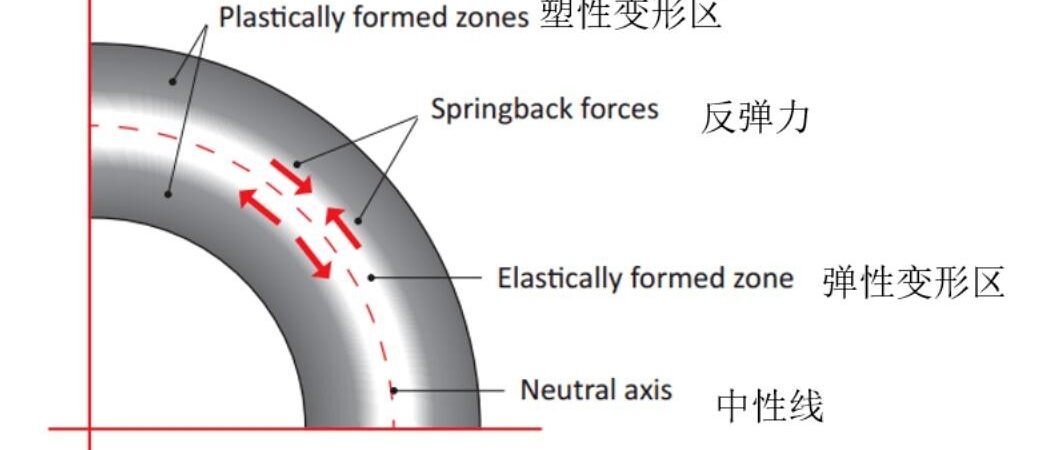
Springback in pipe bending is the elastic recovery of metal after the bending load is removed, causing the final angle to deviate from the target. If you ignore this physical phenomenon, your fabricated parts will fail assembly and waste expensive materials. This guide explains the exact mechanics of springback, how material yield strength dictates the recovery, and the precise engineering methods to compensate for it. By the end, you will know how to adjust your tooling and CNC parameters to achieve perfect angles consistently, utilizing equipment that is CE certified and ships globally within 12 to 18 days.
Understanding Springback in Pipe Bending
When a pipe is bent past its yield point, plastic deformation occurs, but elastic deformation remains. Upon unloading, the elastic portion recovers. This is governed by Hooke’s Law and the material’s modulus of elasticity. For fabricators, this means a 90-degree bend might spring back to 87 degrees. Understanding this elastic recovery is the first step toward achieving tight tolerances in structural and architectural frameworks.
Dimensional accuracy is critical in modern manufacturing. A few degrees of deviation can ruin a complex multi-bend assembly, like a roll cage or a greenhouse frame. According to ASTM A53 standards for seamless and welded steel pipe, dimensional tolerances are strictly specified. Ignoring springback leads to rejected batches, increased scrap rates, and lost profitability. You must treat springback not as an anomaly, but as a predictable variable in your bending process.
Most operators view springback purely as a material property, but it is actually a dynamic function of tooling wear, clamping force, and bend radius. As your bend die wears, the contact area changes, altering the stress distribution and increasing unpredictable springback. Therefore, compensating for springback requires looking beyond the material datasheet and monitoring your physical tooling condition. A well-maintained die with proper clamping pressure reduces elastic recovery variations significantly.
Key Technical Considerations for Compensation
The yield strength and tensile strength of the pipe material directly influence springback. High-strength low-alloy steels or stainless steels exhibit much higher springback than mild steel. The ratio of yield strength to the modulus of elasticity determines the elastic recovery. For instance, bending 304 stainless steel (ASTM A240) requires significantly more overbending than ASTM A36 mild steel. You must calculate the specific recovery factor for each material batch you process.
The Impact of Centerline Radius (CLR)
The bend radius relative to the pipe outer diameter (D/CLR ratio) drastically affects springback. Tighter bends induce more plastic deformation across the cross-section, which actually reduces the relative elastic recovery compared to sweeping bends. However, tight radii increase the risk of wall thinning and ovality. When dealing with a large D/CLR ratio, the outer fibers experience less plastic strain, leading to higher springback. Adjusting your die selection based on the D/CLR ratio is a primary compensation strategy.
Wall Thickness and Tooling Clearance
Wall thickness dictates the moment of inertia of the pipe cross-section. Thicker walls resist elastic recovery more effectively than thin-walled tubes. Furthermore, the clearance between the pipe and the bend die affects the bending mechanics. Excessive clearance allows the pipe to shift, creating inconsistent stress distribution and erratic springback. Using a mandrel bender or a wiper die, as discussed in our guide on how to prevent pipe kinking, ensures the pipe is fully supported, minimizing dimensional variations during the bending cycle.
Temperature and Strain Rate
Although cold bending is standard, ambient temperature fluctuations can slightly alter the yield strength of certain metals, affecting springback consistency. More importantly, the speed of the bending operation (strain rate) influences the material’s flow stress. Faster bending speeds can increase the apparent yield strength, leading to higher springback. CNC machines with programmable bend speeds allow you to standardize the strain rate, ensuring that every part in a production batch experiences identical deformation mechanics.
Step-by-Step Compensation Methods
The most direct method is to overbend the pipe past the target angle. If a material springs back by 3 degrees, you program the machine to bend to 93 degrees. For manual or semi-automatic vertical benders, this requires trial and error. You bend a test piece, measure the springback with a digital protractor, and adjust the mechanical stop or limit switch accordingly. This method is highly effective for single-angle bends in high-volume production.
Bottoming involves forcing the punch and pipe into the bottom of the die cavity at the end of the stroke. This induces plastic deformation at the very apex of the bend, significantly reducing springback. Coining takes this further by applying extreme localized pressure to create a permanent indent, essentially eliminating elastic recovery. While highly accurate, these methods require substantially higher tonnage and can mark the pipe surface. They are best suited for thick-walled pipes where surface aesthetics are secondary.
Advanced CNC platform benders utilize real-time angle measurement. An encoder or linear scale monitors the actual angle during the unloading phase. If the system detects springback, it automatically calculates the deviation and executes a secondary micro-bend to correct the angle. This closed-loop feedback system guarantees precision without manual intervention. For high-mix, low-volume production, this technology is indispensable. Learn more about these systems in our comparison of vertical vs CNC pipe bending machines.
| Method | Mechanism | Accuracy | Tooling Wear | Best Application |
|---|---|---|---|---|
| Overbending | Mechanical/Programmed offset | ±1.0° | Low | High-volume, single bends |
| Bottoming | Plastic deformation at apex | ±0.5° | High | Thick-walled structural parts |
| Coining | Localized extreme pressure | ±0.1° | Very High | Critical aerospace/automotive |
| CNC Closed-Loop | Real-time sensor feedback | ±0.1° | Low | Multi-bend, high-mix batches |
| Stress Relief | Thermal treatment post-bend | ±0.2° | N/A | Complex welded assemblies |
Real Customer Case Study
A mid-sized agricultural equipment manufacturer in Brazil needed to produce support frames for large-scale irrigation systems. They were bending 32mm OD galvanized steel pipes (ASTM A53) with a 2.0mm wall thickness. The application required precise 90-degree bends with a centerline radius (CLR) of 96mm (3×OD). They were producing a batch size of 500 frame sections per week. Their initial budget for equipment was strictly between $800 and $1,200, ruling out expensive hydraulic or full CNC alternatives.
The primary problem they encountered was a consistent 4-degree springback on the 90-degree bends, causing the frames to fail alignment during welding. Additionally, they noticed minor ovality at the extrados due to the tight radius. To solve this within their budget, they purchased our Model 38 Vertical Electric Pipe Bender. To address the springback, the operator adjusted the mechanical limit switch to overbend the pipe to 94 degrees, perfectly compensating for the 4-degree elastic recovery of the galvanized steel.
To resolve the ovality issue, they utilized a custom internal mandrel provided with the machine setup, reducing the ovality to less than 2%. The vertical design of the Model 38 saved them 60% floor space in their cramped workshop. With an operating cost of just $0.15 per bend, they easily achieved their 500-unit weekly target. The consistent angle compensation allowed them to pass strict quality inspections, proving that precise springback control is achievable even with entry-level electric equipment.
Common Mistakes and How to Avoid Them
Steel from different mills can have slightly different yield strengths, altering the springback rate. Fabricators often set a compensation value and forget to test new material batches. Always perform a test bend with every new coil or lot of pipe. Adjust your overbend angle by 1 to 2 degrees based on the test piece measurements before running the full production batch.
As bend dies wear, the radius opens up slightly, and the groove becomes wider. This changes the contact mechanics and increases unpredictable springback. Inspect your dies regularly for galling or wear marks. Replace the die or re-polish the groove when you notice a sudden drift in bend angles. Proper die maintenance is just as critical as your machine calibration for maintaining tight tolerances.
If the clamp die does not hold the pipe securely against the bend die, the pipe will slip during the bending cycle. This slippage causes erratic plastic deformation and inconsistent springback. Ensure your clamp die pressure is set according to the machine manual, typically requiring enough force to prevent any visible movement at the tangent point of the bend.
Product Recommendations
Choosing the right machine depends on your production volume and tolerance requirements. For high-volume, single-bend applications like greenhouse hoops or simple handrails, a vertical electric bender is the most cost-effective choice. These machines rely on mechanical stops for overbending, making them incredibly reliable and easy to set up. They provide excellent value for workshops prioritizing speed and budget over complex multi-bend geometries.
For complex parts with multiple bends and strict angular tolerances, a CNC platform pipe bender is essential. The closed-loop control system automatically compensates for springback in real-time, eliminating the need for manual adjustments between batches. This technology is crucial for automotive roll cages, aerospace fluid lines, and high-end furniture manufacturing where precision is non-negotiable.
| Model | Capacity | Springback Control | Accuracy | Price Range | Best Application |
|---|---|---|---|---|---|
| Model 38 Vertical | 10-38mm OD | Manual/Mechanical Overbend | ±1.0° | $365-$500 | Greenhouse, basic furniture |
| Model 63 Vertical | Up to 63mm OD | Manual/Mechanical Overbend | ±1.0° | $600-$900 | Handrails, agricultural frames |
| Model 76 Vertical | Up to 76mm OD | Manual/Mechanical Overbend | ±1.5° | $900-$1,200 | Heavy structural hoops |
| CNC Platform 3-Axis | Up to 50mm OD | Closed-Loop Auto Compensation | ±0.5° | $5,800-$8,500 | Automotive, complex furniture |
| CNC Platform 5-Axis | Up to 76mm OD | Closed-Loop Auto + Mandrel | ±0.2° | $9,000-$14,000 | Aerospace, high-end architectural |
Frequently Asked Questions
How do I calculate the exact springback angle for my material?
Calculating exact springback requires knowing the material’s yield strength, modulus of elasticity, and the D/CLR ratio. While theoretical formulas exist, practical fabrication relies on empirical testing. Bend a test piece to 90 degrees, measure the final angle with a digital protractor, and subtract the final angle from 90. The difference is your springback angle. Add this value to your target angle for subsequent bends.
Does springback affect thin-walled and thick-walled pipes differently?
Yes, wall thickness significantly impacts springback. Thin-walled pipes are more prone to ovality and cross-sectional distortion, which can complicate the elastic recovery process. Thick-walled pipes have a higher moment of inertia, meaning the outer fibers undergo more plastic deformation relative to the neutral axis. Consequently, thick-walled pipes generally exhibit less percentage springback than thin-walled tubes of the same material and bend radius.
Can I eliminate springback completely without a CNC machine?
You cannot physically eliminate the elastic recovery of metal, but you can neutralize its effect on the final part. Without CNC closed-loop systems, you achieve this through mechanical overbending or bottoming. By forcing the pipe past the target angle and holding it under pressure for a few seconds (dwell time), you maximize plastic deformation and minimize the visible effect of springback, achieving highly accurate results.
How does pipe material hardness affect springback compensation?
Harder materials, such as stainless steel or high-carbon steel, have higher yield strengths and exhibit significantly more springback than mild steel. When bending hard materials, you must increase your overbend angle substantially. Additionally, harder materials increase tooling wear, which can gradually alter your compensation settings. You may need to adjust your overbend angle slightly upward as the production run progresses and the die wears.
Get a Custom Quote
Achieving perfect angle compensation starts with selecting the right equipment for your specific material and production needs. If you are ready to eliminate springback issues and improve your fabrication accuracy, our engineering team is here to help. We provide customized solutions tailored to your exact pipe specifications and budget constraints.
To get an accurate quote, please send us an inquiry detailing your pipe material, outer diameter, wall thickness, and bend radius. Include your target production batch size and the specific tolerance requirements for your application. Whether you need a cost-effective vertical electric bender for high-volume hoops or a precision CNC machine for complex assemblies, we will recommend the optimal configuration. Contact us today to discuss your project and receive a competitive quote within 24 hours.